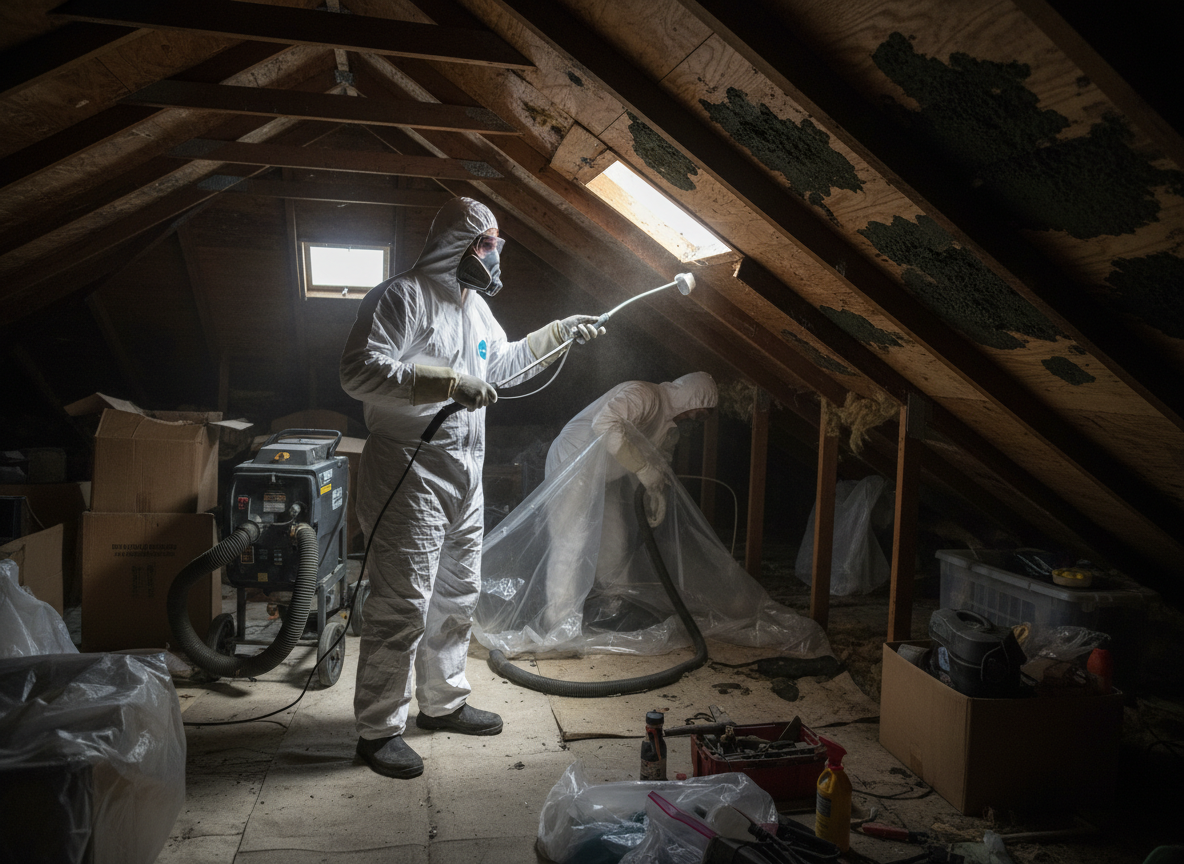
Sunland sits in Los Angeles County with a Mediterranean climate of hot dry summers and mild winters. Older housing stock in Sunland Village and Foothill Trails often features vented attics that collect condensation when winter moisture meets summer heat buildup. Roof leaks near Angeles National Forest trailheads or poor ridge venting allow spores to settle on insulation and rafters. Testing starts with air and surface samples before any disturbance to avoid spreading spores into living spaces below.
Removal in these neighborhoods requires isolating the attic, HEPA vacuuming, and treating wood members without damaging original plaster or lath in pre-1960 homes common here. Dry summers can mask active growth until a sudden rain event in Tujunga Canyon pushes water under shingles. Crews bag and remove insulation in sealed chutes to prevent cross-contamination with Sylmar-adjacent properties. Post-remediation clearance testing confirms spore levels match outdoor baselines before re-insulation.
Access challenges arise on sloped lots near Sunland Park where attic hatches sit above finished spaces. Negative air machines exhaust through roof jacks to avoid pulling spores into Foothill Trails homes. Owners often discover hidden growth only after noticing musty odors during the first cool evenings of fall. Proper containment prevents migration into HVAC returns that serve multiple rooms below.
Technician insight
In Sunland the thing that catches most people out with Attic mold testing and removal is the way our dry summers let small roof leaks go unnoticed until the first winter storm pushes water across rafters in Foothill Trails homes; by then spores have already settled into the old blown-in insulation common in Sunland Village houses.
Hidden growth after roof repair
A homeowner in Sunland Village noticed a musty smell after a contractor replaced a section of roof. Inspection found active growth on rafters where water had wicked under old felt paper. We isolated the attic, removed the insulation, treated the wood, and cleared the space with follow-up samples before the owner re-insulated.
How it works
- 1
Initial Inspection
Technician enters the attic from 8337 Foothill Blvd base to map moisture sources and visible growth using moisture meters and borescopes.
- 2
Sampling and Containment
Air and tape-lift samples are collected, then plastic sheeting seals the attic hatch and HVAC registers before any material disturbance.
- 3
Removal and Cleaning
Affected insulation is bagged, wood surfaces are HEPA-vacuumed and treated, and debris exits through exterior roof access when possible.
- 4
Clearance Testing
Post-cleanup samples verify spore counts; a written report is provided before insulation replacement begins.
Pricing
Cost depends on attic size, insulation depth, and whether roof access or HVAC cleaning is required.