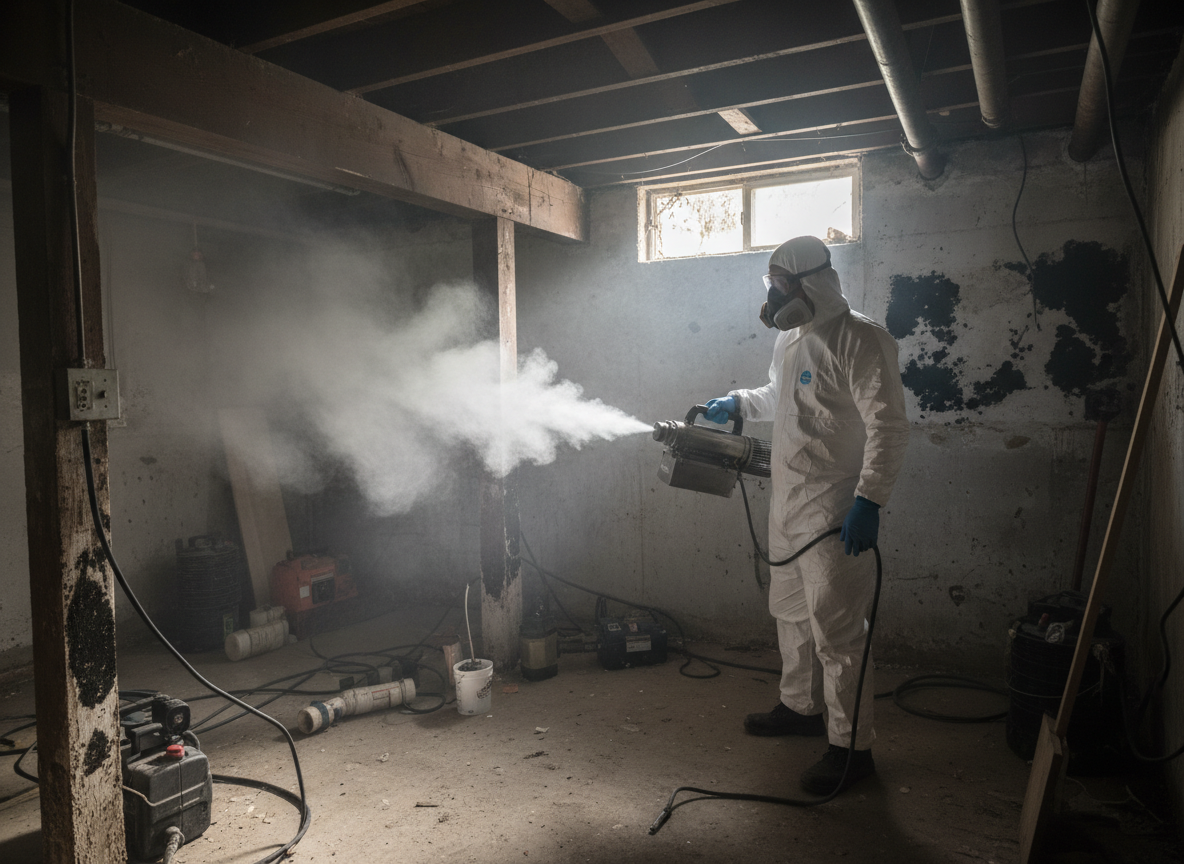
Mold fogging treatment disperses EPA-registered antimicrobials as a fine mist that penetrates cracks, behind drywall, and into attic insulation where surface wiping alone fails. In Los Angeles County homes built before the 1970s, common in Sunland Village and Foothill Trails, settling foundations and hillside drainage often create hidden moisture pockets that fog reaches without demolition. The Mediterranean climate brings brief winter rains followed by hot dry summers that drive residents to close windows, trapping humidity inside older single-story ranch houses near Sunland Park.
Technicians select fog particle size based on the structure: smaller particles travel farther into ductwork while larger droplets settle on visible surfaces in garages and laundry rooms. Edge cases include properties backing Angeles National Forest trailheads where wind-blown spores re-enter through attic vents, requiring repeat applications after the first fog. Los Angeles County building codes require proper ventilation post-treatment to avoid trapping residues, and crews document airflow paths before starting so homeowners in Sylmar or Tujunga understand why certain rooms stay sealed for 24 hours.
Fogging is never used as a standalone fix when active leaks exist; crews first trace water sources from rooflines or plumbing that are frequent in the area's mild winters. Materials include low-residue formulas safe for occupied homes once dried, but technicians still isolate HVAC systems to prevent circulation into living spaces. Homeowners along Foothill Boulevard often discover the treatment also reduces musty odors that travel between neighboring properties built on shared slopes.
Technician insight
In Sunland, the thing that catches most people out with mold fogging treatment is assuming dry summers eliminate the need for follow-up checks. Older homes in Sunland Village sit on slopes where winter rain pools against foundations for weeks, then the heat bakes it into wall cavities that fog alone cannot dry. Homeowners near Tujunga often skip checking attic vents after fogging and end up with the same spores drifting back in from Angeles National Forest.
Sunland Village Attic Fogging
A single-story home near Sunland Park showed recurring musty smell after winter rains despite surface cleaning. Inspection found settled insulation holding moisture from a slow roof leak common on the area's slopes. Crews corrected the leak, applied fog through the attic access, and ventilated for a full day. The odor did not return after the next rain cycle.
How it works
- 1
Inspection and Containment
Technicians walk the property to locate moisture sources and set up containment barriers around affected zones in attics or crawlspaces typical of Sunland hillside homes.
- 2
Source Correction
Any active leaks or drainage issues near Sunland Park properties are addressed before fogging begins to prevent recurrence.
- 3
Fog Application
Antimicrobial fog is released using equipment calibrated for the home's square footage and layout, reaching behind walls and into insulation.
- 4
Ventilation and Clearance
After the required dwell time, fresh air is introduced and surfaces are checked before residents return to the space.
Pricing
Cost depends on square footage, number of stories, and whether hidden moisture pockets require extra prep in older Foothill Trails homes; upfront quotes provided after inspection.