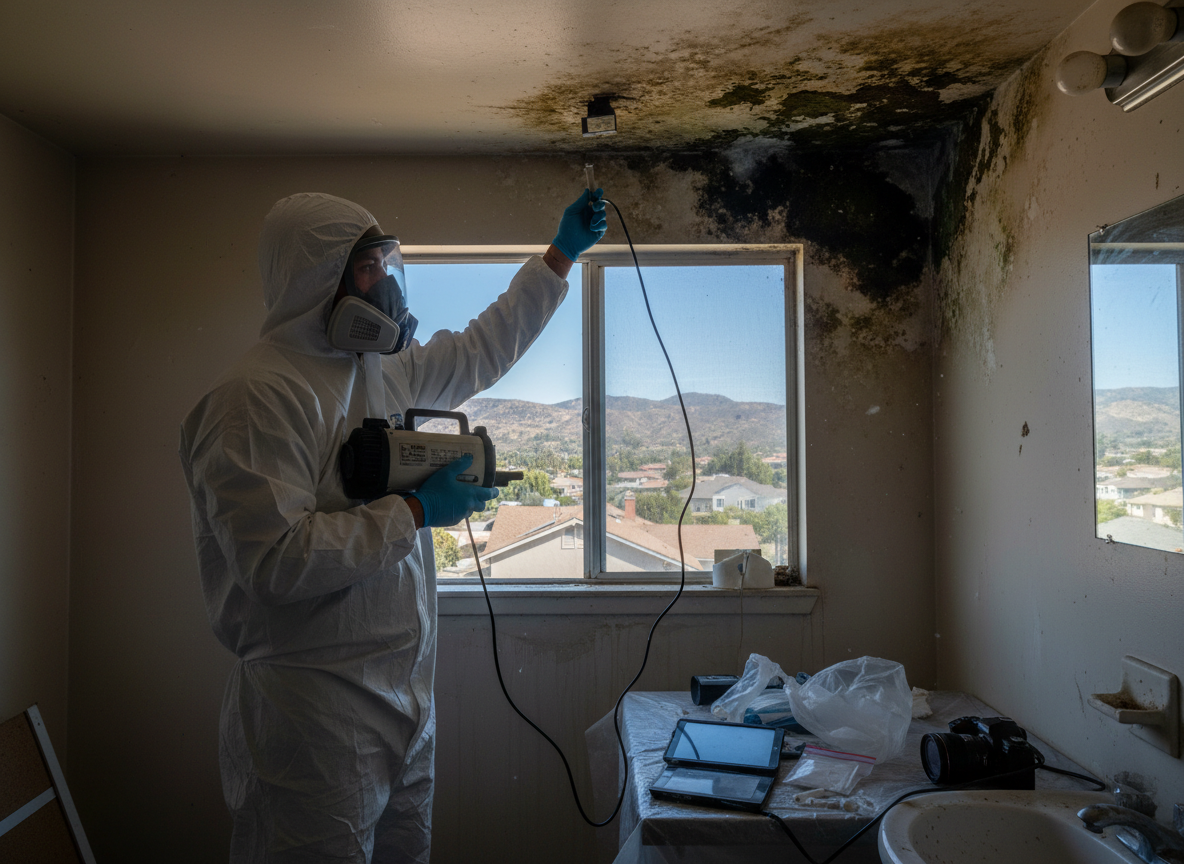
Mold spore testing in Sunland requires accounting for the Mediterranean climate where hot dry summers alternate with mild winters that bring enough rain to drive moisture into older stucco and wood-frame homes common in Sunland Village. Air sampling often reveals elevated outdoor spores drifting in from Angeles National Forest trailheads, so technicians must establish baseline comparisons before declaring indoor amplification. Surface sampling on drywall and attic sheathing catches the hidden colonies that form after winter seepage along the foothills.
Los Angeles County building practices from the 1950s and 1960s left many properties in Foothill Trails with limited ventilation and crawl spaces that trap humidity during the cooler months. Testing protocols here include both viable and non-viable spore counts because the dry summer air can mask active growth until the first rains arrive. Technicians also check HVAC systems that pull air from near Sylmar and Tujunga, where wind patterns carry additional spores across the valley.
Edge cases frequently involve post-rain intrusion through cracked foundations or poorly sealed windows facing the national forest slopes. Sampling must extend to insulation behind bathroom walls and under kitchen sinks where leaks go unnoticed for years. Reports include spore type identification so homeowners know whether the issue stems from local Penicillium or Aspergillus common after seasonal moisture events.
Seasonal Testing Guidance
Schedule air sampling after the first significant winter rain and again in late summer when outdoor spore loads peak from the surrounding hills. This timing captures the shift between dry and wet periods that actually drives indoor growth in Sunland properties.
Technician insight
In Sunland the thing that catches most people out with mold spore testing is assuming dry summer air means no problem when older homes in Sunland Village actually hold winter moisture in unvented crawl spaces that the foothills terrain keeps shaded.
Foothill Trails Attic Testing
A homeowner in Foothill Trails noticed a musty odor after winter rains. Sampling revealed elevated Aspergillus spores in the attic where roof runoff had entered through aging flashing near the national forest boundary. Targeted air and surface samples confirmed the source and guided focused removal without whole-house disruption.
How it works
- 1
Initial Consultation
Discuss visible signs, recent leaks, and property history while noting exposure to Angeles National Forest winds.
- 2
On-Site Sampling
Collect air and surface samples from multiple zones including attics, crawl spaces, and HVAC returns in Sunland Village homes.
- 3
Laboratory Analysis
Send samples for spore identification and concentration counts to determine if indoor levels exceed outdoor baselines.
- 4
Detailed Report
Deliver findings with location-specific recommendations for Foothill Trails and nearby neighborhoods.
Pricing
Cost depends on number of samples, property size, and whether HVAC or crawl space access is required.